




Martin McDonagh Triumphs Again in Venice — and Six Shooter Deserves Another Look
Martin McDonagh has once again turned the Venice Film Festival into the opening act of a major awards campaign. His latest feature, Wild Horse Nine, premiered at the 83rd Venice International Film Festival to an enthusiastic reception, including a reported 13-minute standing ovation. The festival ultimately awarded John Malkovich the Volpi Cup for Best Actor for his performance in the film.
Set against the political turmoil surrounding Chile’s 1973 military coup, Wild Horse Nine stars Malkovich and Sam Rockwell as two CIA officers sent from Santiago to Easter Island. What begins as an offbeat mission gradually becomes a story about responsibility, memory, and the psychological weight of participating in history.
It is familiar McDonagh territory: damaged men, sharp dialogue, sudden violence, and comedy that makes the tragedy feel even more unsettling. The filmmaker has explained that the project evolved from a relatively simple comedy into something darker and more reflective, centered on guilt and regret.
The response in Venice has naturally revived interest in McDonagh’s earlier work. That includes his celebrated features In Bruges, Seven Psychopaths, Three Billboards Outside Ebbing, Missouri, and The Banshees of Inisherin. Yet the most revealing place to begin exploring his cinema may be his first film: the 27-minute short Six Shooter.
A miniature version of McDonagh’s cinematic universe
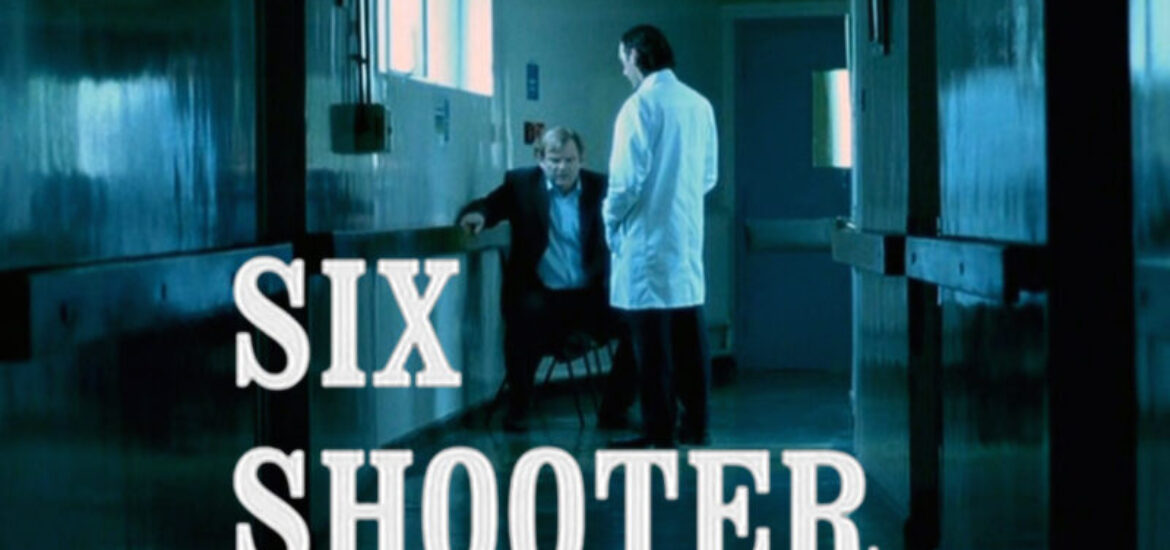
Released in 2004, Six Shooter stars Brendan Gleeson as Donnelly, a grieving man whose wife has just died. On the train home, he encounters a strange, aggressive, and possibly dangerous young passenger played by Rúaidhrí Conroy.
From that modest premise, McDonagh creates a compact comic tragedy filled with death, cruelty, absurd conversations, and flashes of unexpected tenderness. The Irish countryside passes quietly outside the train while the situation inside becomes increasingly surreal and violent.
Almost everything that would later define McDonagh’s feature films is already present. His characters use humor as a weapon and a defense mechanism. Violence arrives abruptly, but never without moral consequences. Grief and laughter occupy the same scene, sometimes the same sentence.
Brendan Gleeson is essential to that balance. He gives Donnelly a weary humanity that prevents the film from becoming merely an exercise in shock and black comedy. Behind his confusion and silence is a man attempting to process a loss that ordinary language cannot contain.
The short also includes a small but historically interesting appearance by Gleeson’s son, Domhnall Gleeson. Playing a vendor aboard the train, he made his screen acting debut in the film.
An Oscar-winning beginning
Six Shooter was McDonagh’s first transition from theater to filmmaking. Shot on location in Wicklow, Waterford, and Rosslare, it was co-financed by the Irish Film Board and FilmFour Lab as a project supporting emerging filmmaking talent.
The experiment produced an extraordinary result. The film won the Academy Award for Best Live Action Short Film in 2006, giving McDonagh an Oscar before he had directed a single feature.
Seen today, Six Shooter does not feel like a tentative debut. It feels like a concentrated statement of intent. In Bruges would later expand its mixture of guilt, violence, melancholy, and deadpan comedy. Three Billboards would bring its moral anger to the American landscape. The Banshees of Inisherin would transform a broken friendship into an almost mythological study of loneliness and self-destruction.
Now Wild Horse Nine appears ready to begin another McDonagh awards-season journey. Venice has placed the director and his remarkable cast back at the center of international film conversation. For viewers discovering his work — or returning to it — Six Shooter remains the ideal starting point: short, savage, painfully funny, and unmistakably McDonagh.