









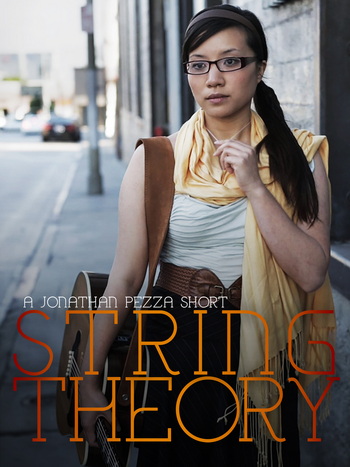
Today our watcher`s spotlight goes to Jonathan Pezza’s String Theory.
From the very beginning, this was designed as a festival film, and it shows. Despite its modest runtime, String Theory has the polish of a full-fledged Hollywood production, complete with recognizable performers playing fictionalized versions of themselves and featuring their own original music.
While names like Paulina Cerilla and Abraham Benrubi may not immediately resonate with international audiences outside of country and singer-songwriter circles, they represent something much bigger across California and throughout small-town America. They belong to the same musical tradition that produced artists like Bob Dylan and Tom Petty, carrying the spirit, authenticity, and storytelling that define classic American songwriting.
I was also pleasantly surprised to see Disney’s veteran Kee Chan appear in a small role. His cameo feels natural, fitting seamlessly into the film’s world alongside the rest of the cast.
As someone with a degree in film directing, I couldn’t help imagining how the story might have gone one step further.
The film already revolves around guitars. Throughout the story, nearly every character loses a beloved instrument and eventually acquires another. To me, the guitars themselves could have become the invisible thread connecting everyone.
Imagine one musician pawning a guitar that is later bought by another character. A young woman accidentally breaks her instrument, then impulsively steals another guitar from a music store – one that actually belongs to someone else. The original owner, meanwhile, repairs the broken guitar, only to discover it’s an extraordinary instrument because it was the only thing the woman inherited from her father, Leo Fender. She had brought it with her from Anaheim to Los Angeles while chasing her dream. With his own guitar stolen, he takes her restored instrument to a country music festival.
There, the characters recognize their guitars and slowly realize that the instruments have been bringing them together all along, finding their way back to the people they truly belong with.
Only one explanation remains: the mysterious String Theory.
Yes, that version of the story would be simpler. But it would also give the title an entirely new layer of meaning. It would become a story about loyalty, about never abandoning your friends, about how a great instrument becomes an extension of its musician, and, above all, about music’s remarkable ability to connect people whose lives might never have crossed otherwise.
Jonathan Pezza chose a different path, and the film succeeds on its own terms. It remains a beautifully crafted short with genuine warmth and a deep appreciation for music and the people who create it.
On a personal note, String Theory holds a special place in my journey. Three years ago, it became the very first trailer I ever edited for a short film. Looking back now, I realize that project quietly set me on the artistic path I’ve been following ever since.