









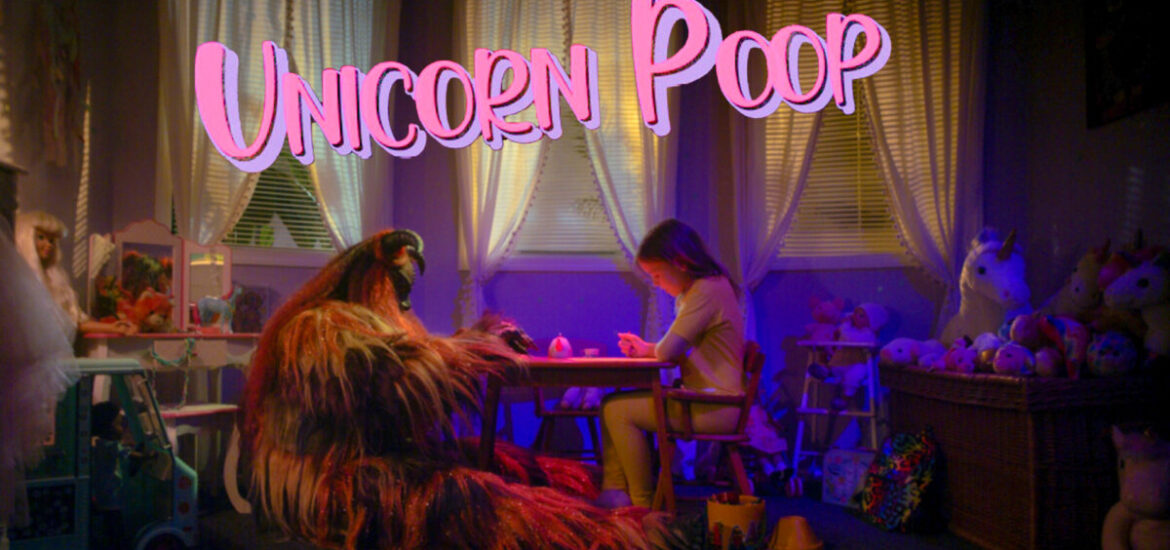
Unicorn Poop. Release your inner monsters!
Unicorn Poop, the 2022 short film written and directed by Lorna Street Dopson, has quietly made an impact in the world of indie shorts — and for good reason. Clocking in at just 12 minutes, this deceptively simple comedy-drama explores deeply human themes: fear, memory, protection, and the imaginary monsters we carry with us.
At its core, the film follows Laura (played by Dopson), who has lived all her life with a monster in her closet. But this isn’t the kind of monster that simply haunts in shadows — instead, it’s been her secret guardian, her very real (to her) protector. As an adult, Laura is forced to assess the nature of her relationship with this creature: does she still need its protection, or has she grown past it?
That tension — between childhood safety and adult independence — powers Unicorn Poop. It is both “harrowing and uplifting,” as described on platforms like Apple TV, which distribute the film. Dopson’s direction is subtle, never opting for over-the-top horror or melodrama. Instead, she leans into small, intimate moments, lending the monster a specificity and warmth that avoids clichés.
Despite its short runtime, Unicorn Poop has resonated in the festival circuit. During the 2022 Louisiana Film Prize, the film was among the top five finalists, recognized alongside other strong entries. Notably, the Louisiana Film Prize jury and audience awarded director Dopson a Founder’s Circle Grant, signaling confidence in both the film’s quality and its creator’s potential. On Fable House’s blog, coverage of the event noted the film’s evocative tagline: “A girl makes a deal with the monster in her closet.”
Because Unicorn Poop is a short, critical reviews from major outlets are relatively sparse — it doesn’t have a Tomatometer score yet on Rotten Tomatoes. But absence of reviews doesn’t mean absence of impact. The film seems to connect most strongly with viewers who appreciate psychological realism and metaphorical storytelling. Its emotional honesty and mellow humor leave space for reflection rather than offering tidy resolutions.
From a thematic standpoint, Unicorn Poop raises provocative questions. What does it mean to “outgrow” our fears? Is growth simply the shedding of protective illusions, or does true maturity involve understanding and integrating them? By personifying Laura’s inner demon as a literal creature, the film externalizes internal conflict — making vulnerable those parts of ourselves that are often hidden and unexplored.
The monster in Laura’s closet is not some grotesque, terrifying beast — it’s a companion, a witness to her memories, and an embodiment of her survival strategy. This is a clever and gentle twist on the trope of “imaginary friend” or “monster under the bed.” Rather than being purely frightening, the monster represents resilience and the complicated nature of comfort.
Some viewers might interpret the film as a commentary on mental health: the monster could be a metaphor for anxiety, trauma, or the emotional baggage we carry. Others might see it more innocently: as a tribute to childhood imagination and the bittersweet process of letting go. Either way, Unicorn Poop doesn’t decide for you. Its ambiguity is its strength.
Lorna Street Dopson’s performance is quietly powerful. Her portrayal of Laura feels grounded and human, and the chemistry between her and the monster-figure is tender without becoming saccharine. The script is economical — every bit of dialogue, every pause, serves to deepen our understanding of Laura’s inner life.
Visually, the short film leans into stark contrasts: the darkness of the closet, the silhouette of the monster, and the light of Laura’s room. These elements create a mood that feels intimate, slightly uncanny, yet deeply personal.
In a broader context, Unicorn Poop is part of a wave of short films that tackle mental health and childhood trauma not through grand spectacle, but through small, intimate stories. It reminds us that sometimes, the most powerful monsters are the ones we carry within — and that letting them go, or at least coming to terms with them, is less about vanquishing and more about understanding.
In conclusion, Unicorn Poop may be short in runtime, but it’s long on emotional resonance. It is a quietly brave film that asks difficult questions about protection, growth, and self-acceptance. For those who catch it on a streaming platform or at a festival, it’s likely to linger in the mind long after the credits roll.
What makes Unicorn Poop stand out is its ability to capture the weirdness of childhood imaginings without descending into pure fantasy. The monster isn’t a roaring beast — it’s familiar, almost banal, yet meaningful. It’s not about vanquishing fear so much as understanding it. The film suggests that maybe the monsters we carry are part of who we are — and letting them go isn’t always as simple as we hope.
Watch Unicorn Poop short film now with Shorts.TV subscription on Amazon Prime video.